
Supporting Case · Bathroom Manufacturing · Export Website
Turning a product catalog into a clearer path for export buyers.
For a focused product range, the priority was not adding more pages. It was connecting product discovery, manufacturing proof, project evidence and inquiry into one clear buyer path.
The Gap
A straightforward product business still needs more than product pages.
The website had to answer the practical questions an overseas buyer asks before contacting a bathroom supplier: what do you make, can you manufacture reliably, where has it been used, what evidence do you have, and how do I inquire?
Buyer Evaluation
Show the range first. Then give buyers reasons to keep evaluating.
The site moves from category discovery into selected models, then adds the supplier proof a buyer needs before sending an inquiry.
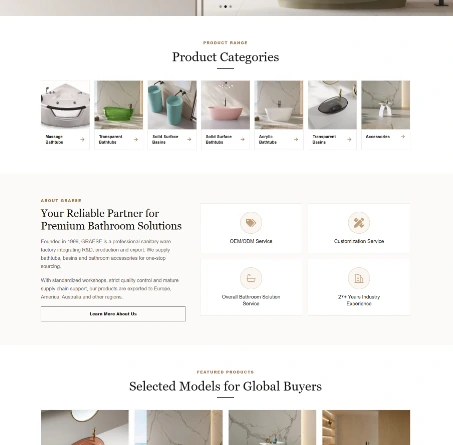
The product range is structured to stay easy to scan while still giving buyers a clear path into evaluation.
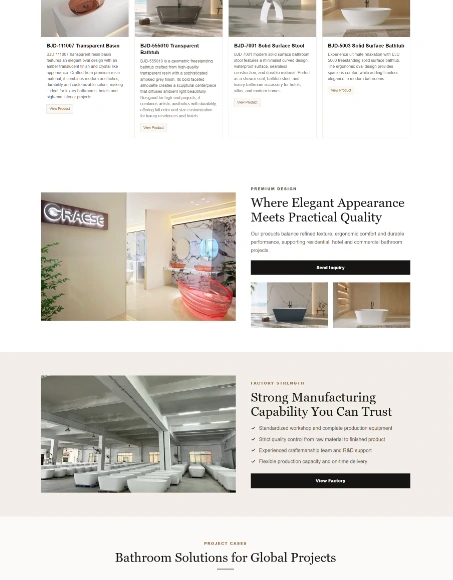
Real supplier context supports the product range instead of leaving the buyer with product imagery alone.
What Changed
The site was structured around the minimum evidence an export buyer needs to move forward.
Supporting Evidence
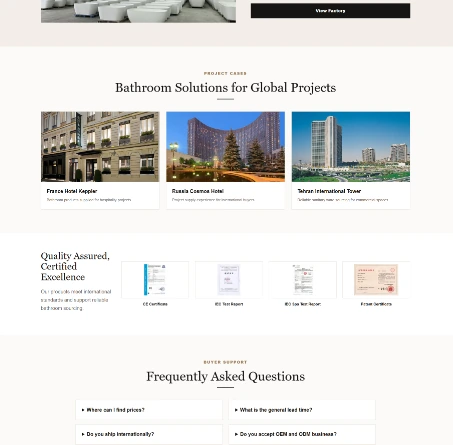
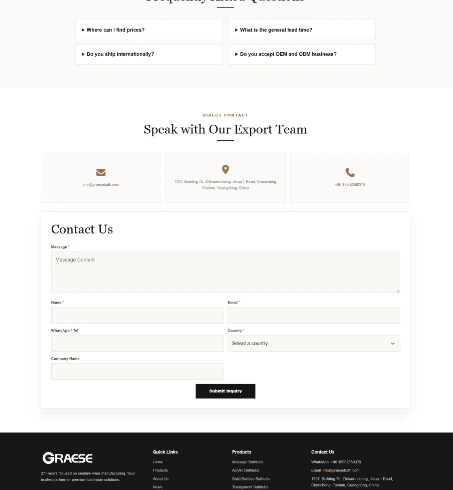
Project proof and certification sit close to the buying path.
The Bottom Line
The right B2B website is not the most complex one. It is the one that removes the buyer’s next question.
For GRAESE, that meant connecting product range → supplier proof → project evidence → inquiry in a focused buyer journey, with architecture sized to the decisions buyers actually need to make.
Does your website give buyers enough confidence to inquire?
Build the website around what buyers need to understand, verify and do next.
Send us your current website, product range and target market. We’ll identify what buyers need to understand, verify and do next — then shape the architecture around that path.
Start with the business and buyer questions, then decide which structure best supports the buying path.
Discuss Your Website →