
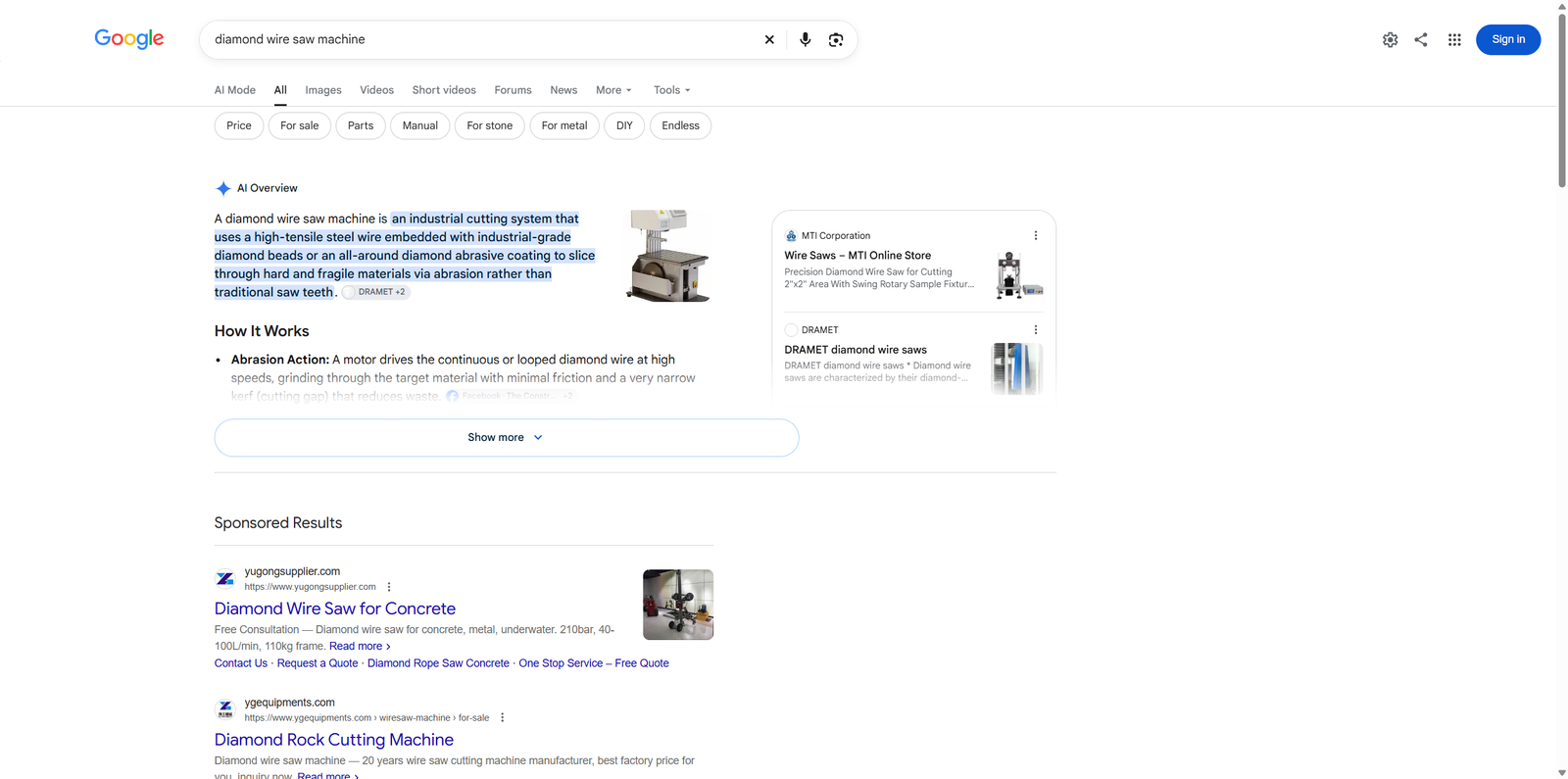
When I searched Google for “diamond wire saw machine,” the interesting part was not a list of rankings. In one saved result, I could see ads for heavy-duty cutting equipment, a precision wire-saw supplier, and a product module on the same screen. In another, Google explained the machine in an AI Overview before showing paid results. These are different routes to attention, but they do not necessarily lead to the same buyer. [E01, E04]
My question as someone building digital growth systems for manufacturers is simple: Can the right overseas buyer tell what a factory actually makes before sending an enquiry? I use search-result evidence to work backward from that question to the website’s product structure, technical content, proof, and contact path.
1. The ad space is crowded, but the equipment categories are not identical
In the U.S.-set capture for “diamond wire saw machine,” the visible Sponsored Results include cahardtools.com, yugongsupplier.com, and ygequipments.com. Their snippets discuss large cutting machines, concrete cutting, or similar heavy-duty use cases. Beneath the ads, MTI Corporation appears with a Wire Saws result describing a precision machine, followed by a product module. The screenshot shows paid, organic, and product results together. It does not establish their overall search rankings or how much anyone spent on ads. [E01]

This changes how I assess a manufacturer’s competition. A precision wire-saw maker may share a broad phrase with a concrete-cutting advertiser while selling to a very different buyer. I would not respond by copying the advertiser’s wording. I would first make the machine architecture, workpiece, and intended application unmistakable on the manufacturer’s own pages.
2. Google’s AI answers can introduce specific suppliers before a buyer clicks
In the Germany-set English search for the same equipment term, an AI Overview explains diamond-wire cutting of hard and fragile materials. Its visible source cards include MTI Corporation and DRAMET. Sponsored Results follow below the AI answer. This is a useful observation: specific supplier pages were cited in that captured AI explanation. It is not proof that a particular GEO technique earned those citations. [E04]
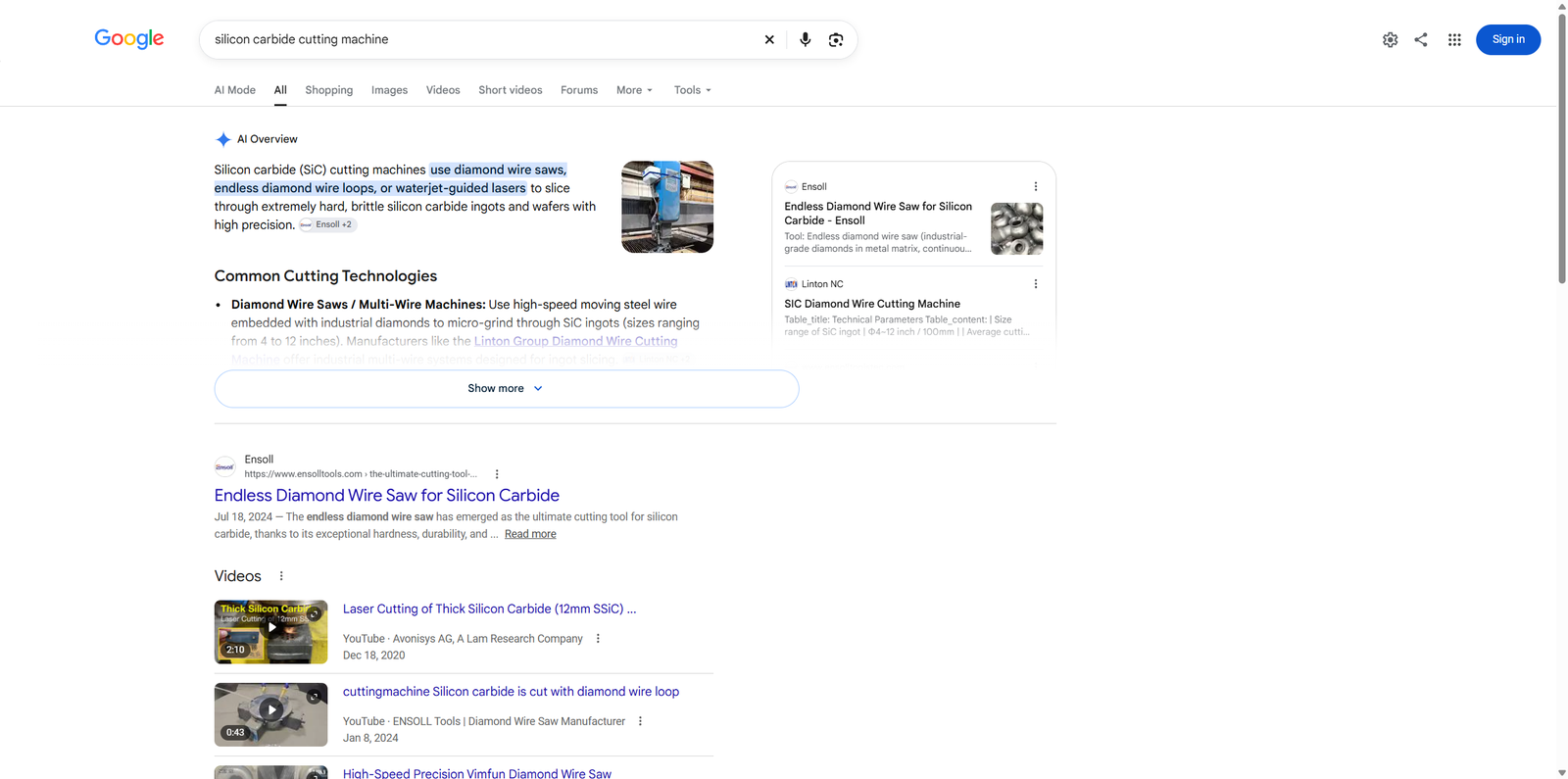
A second example is even more relevant to specialized manufacturers. In a U.S.-set search for “silicon carbide cutting machine,” the AI Overview shows source cards from Ensoll and Linton NC. The visible explanation also names a Linton diamond-wire cutting machine. A named manufacturer can therefore appear inside an AI answer about a material-processing problem, not only in a standard list of links. [E10]
I would not promise any factory that publishing technical pages will get it cited. What I can recommend is making the underlying information worth understanding: the actual process, machine configuration, tested materials, workpiece limits, cutting demonstrations, and the conditions behind performance claims. That gives both people and search systems something concrete to interpret.
3. A shared keyword can hide three different purchasing problems
The broad diamond-wire search landscape includes precision equipment such as MTI’s Wire Saws, consumables such as Mesa Diamond’s wire for concrete and stone, and construction-oriented machines such as Hilti’s wire saws. They are related by words and technology, not necessarily by customer requirements. [E01, E02, E03]
For a factory website, “Diamond Wire Saw Machine Supplier” is not a sufficient product explanation. I would want to answer: Is this a laboratory precision saw, an endless-loop wire system, or a construction machine? Which workpieces has the factory actually cut? What machine models, specifications, and test records can it show?
The website should then connect an accurate equipment category to distinct series and models, with technical application pages where the buyer’s question is genuinely different. Creating nearly identical pages for “diamond wire saw machine” and “diamond wire cutting machine” would not solve this ambiguity. The archived examples suggest these phrases can share equipment-oriented intent; I would test any proposed page split against real enquiries and Search Console data. [E01, E06]
4. Material searches are where the technical explanation matters
The “silicon carbide cutting machine” result does not describe one universal method. The same saved capture includes the AI answer about diamond-wire systems and a video result about laser cutting thick silicon carbide. The searcher specified a material, but still needs to understand which process fits the actual workpiece and production goal. [E10, E11]
Similarly, a search for “optical glass cutting machine” can surface lens-related equipment, which is not automatically the same purchasing category as precision cutting of optical-glass blocks. [E12]
My preferred application-page structure is practical: material → workpiece → cutting method → suitable machine → test evidence → enquiry. Every compatibility or performance statement needs to be limited to what the factory has actually verified.
5. What I would deliver in a search-led website review
A screenshot only becomes commercially useful when it leads to a decision. I would turn the observations into a short audit with explicit outputs:
| What I check | What the manufacturer receives |
|---|---|
| Paid, organic, product, video, and AI-result types | A map of what buyers may encounter before reaching the website |
| Which machine or process each result actually represents | Clear category and positioning gaps, without treating every keyword match as a direct competitor |
| Queries versus equipment hubs, series, models, and applications | A page-to-query map and a list of pages to consolidate, improve, or create |
| Machine evidence and buyer questions | A prioritized list of genuine photos, cutting demos, test conditions, and specifications to publish |
| Contact path and post-launch performance | Specific enquiry-path changes and a plan to review Search Console and qualified enquiries |
The decision sequence is inspect the SERP → identify the real machine categories → map the buyer questions to pages → add verifiable evidence → check what happens after publication. I would rather show a factory one point where the wrong buyer may misunderstand its equipment than hand over a hundred keywords without a website plan.
Want to see where buyers may misunderstand your equipment?
If your factory makes specialized machinery and your website is difficult to distinguish from other equipment categories, contact RONGJING DIGITAL to discuss a search-led website review. I can explain which search results I would inspect, which product claims need proof, and which pages I would prioritize before proposing more content.
Evidence and scope
This article uses Google screenshots saved on October 19–20, 2026. The archive covers seven English query themes under seven geographic settings (US, GB, DE, JP, KR, SG, and VN), with 19 annotated observations linked to 16 distinct original screenshots. The findings above describe the visible results in selected captures, not traffic estimates, market share, or a causal test of AI optimization.
All searches in this archive were conducted in English. A query under a German, Japanese, or Korean geographic setting is not the same as a German-, Japanese-, or Korean-language search study. Translated editions of this article must preserve that distinction.
Evidence IDs refer to archived full-resolution Google screenshots. Their capture times, query URLs, and SHA256 hashes are recorded separately. Screenshot file suffixes such as “p02” or “p03” identify scroll-capture segments, not Google results pages or ranking positions. Any separately matched supplier webpage is background context, not a verified reproduction of Google’s original click destination.
Author: Chen Rongjing, Founder of RONGJING DIGITAL. This is an independent analysis of publicly visible search results, not a report on any named manufacturer’s private advertising performance or customer data.
B2B Website Review
Share your current website and the problem you want to resolve.
Request this review